Command To Generate Machine Keys In Hadoop
#Use SSH with Linux-based Hadoop on HDInsight from Windows
[AZURE.SELECTOR]
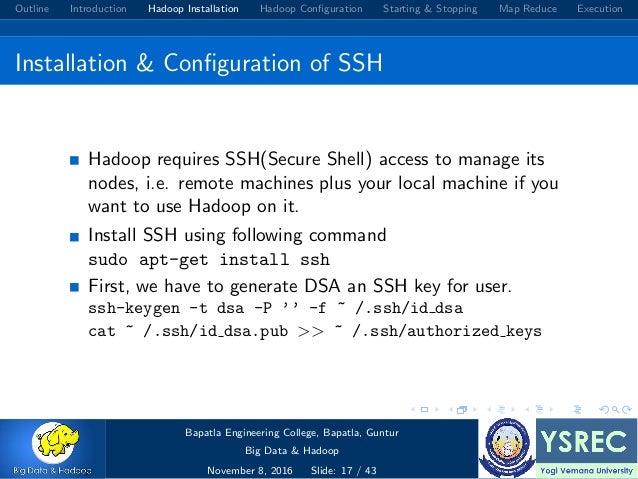
Oct 22, 2013 Hadoop Installation on Local Machine or Local Host. After the SSH server installation. We have to generate an SSH key for the hduser. $ su - hduser $ ssh-keygen -t rsa -P ' Here the second command will generate a key pair with an empty password. Note: Empty key is not recommended but here we are putting the key as empty as we don't want to. Sqoop is a tool designed to transfer data between Hadoop and relational databases. You can use Sqoop to import data from a relational database management system (RDBMS) such as MySQL or Oracle into the Hadoop Distributed File System (HDFS), transform the data in Hadoop MapReduce, and then export the data back into an RDBMS. Nov 10, 2011 How to Generate A Public/Private SSH Key Linux By Damien – Posted on Nov 10, 2011 Nov 18, 2011 in Linux If you are using SSH frequently to connect to a remote host, one of the way to secure the connection is to use a public/private SSH key so no password is transmitted over the network and it can prevent against brute force attack. Then you can run Hive commands. ##Add more accounts. Generate a new public key and private key for the new user account, as described in the Create an SSH key section. AZURE.NOTE The private key should either be generated on a client that the user will use to connect to the cluster, or securely transferred to such a client after creation. Keytab files are not bound to the systems on which they were created; you can create a keytab file on one computer and copy it for use on other computers. Following is an example of the keytab file creation process using MIT Kerberos.
Secure Shell (SSH) allows you to remotely perform operations on your Liux-based HDInsight clusters using a command-line interface. This document provides information on connecting to HDInsight from Windows-based clients by using the PuTTY SSH client.
[AZURE.NOTE] The steps in this article assume you are using a Windows-based client. If you are using a Linux, Unix, or OS X client, see Use SSH with Linux-based Hadoop on HDInsight from Linux, Unix, or OS X.
##Prerequisites
PuTTY and PuTTYGen for Windows-based clients. These utilities are available from http://www.chiark.greenend.org.uk/~sgtatham/putty/download.html.
A modern web browser that supports HTML5.
OR
- Azure CLI for Mac, Linux and Windows.
##What is SSH?
SSH is a utility for logging in to, and remotely executing, commands on a remote server. With Linux-based HDInsight, SSH establishes an encrypted connection to the cluster head node and provides a command line that you use to type in commands. Commands are then executed directly on the server.
###SSH user name
An SSH user name is the name you use to authenticate to the HDInsight cluster. When you specify an SSH user name during cluster creation, this user is created on all nodes in the cluster. Once the cluster is created, you can use this user name to connect to the HDInsight cluster head nodes. From the head nodes, you can then connect to the individual worker nodes.
###SSH password or Public key
An SSH user can use either a password or public key for authentication. A password is just a string of text you make up, while a public key is part of a cryptographic key pair generated to uniquely identify you.
A key is more secure than a password, however it requires additional steps to generate the key and you must maintain the files containing the key in a secure location. If anyone gains access to the key files, they gain access to your account. Or if you lose the key files, you will not be able to login to your account.
A key pair consists of a public key (which is sent to the HDInsight server,) and a private key (which is kept on your client machine.) When you connect to the HDInsight server using SSH, the SSH client will use the private key on your machine to authenticate with the server.
##Create an SSH key
Use the following information if you plan on using SSH keys with your cluster. If you plan on using a password, you can skip this section.
Open PuTTYGen.
For Type of key to generate, select SSH-2 RSA, and then click Generate.
Move the mouse around in the area below the progress bar, until the bar fills. Moving the mouse generates random data that is used to generate the key.
Once the key has been generated, the public key will be displayed.
For added security, you can enter a passphrase in the Key passphrase field, and then type the same value in the Confirm passphrase field.
[AZURE.NOTE] We strongly recommend that you use a secure passphrase for the key. However, if you forget the passphrase, there is no way to recover it.
Click Save private key to save the key to a .ppk file. This key will be used to authenticate to your Linux-based HDInsight cluster.
[AZURE.NOTE] You should store this key in a secure location, as it can be used to access your Linux-based HDInsight cluster.
Click Save public key to save the key as a .txt file. This allows you to reuse the public key in the future when you create additional Linux-based HDInsight clusters.
[AZURE.NOTE] The public key is also displayed at the top of PuTTYGen. You can right-click this field, copy the value, and then paste it into a form when creating a cluster using the Azure Portal.
##Create a Linux-based HDInsight cluster
When creating a Linux-based HDInsight cluster, you must provide the public key created previously. From Windows-based clients, there are two ways to create a Linux-based HDInsight cluster:
Azure Portal - Uses a web-based portal to create the cluster.
Azure CLI for Mac, Linux and Windows - Uses command-line commands to create the cluster.
Each of these methods will require the public key. For complete information on creating a Linux-based HDInsight cluster, see Provision Linux-based HDInsight clusters.
###Azure Portal
When using the Azure Portal to create a Linux-based HDInsight cluster, you must enter an SSH Username, and select to enter a PASSWORD or SSH PUBLIC KEY.
If you select SSH PUBLIC KEY, you can either paste the public key (displayed in the Public key for pasting into OpenSSH authorized_keys file field in PuttyGen,) into the SSH PublicKey field, or select Select a file to browse and select the file that contains the public key.
This creates a login for the specified user, and enables either password authentication or SSH key authentication.
###Azure Command-Line Interface for Mac, Linux, and Windows
You can use the Azure CLI for Mac, Linux and Windows to create a new cluster by using the azure hdinsight cluster create command.
For more information on using this command, see Provision Hadoop Linux clusters in HDInsight using custom options.
##Connect to a Linux-based HDInsight cluster
Open PuTTY.
If you provided an SSH key when you created your user account, you must perform the following step to select the private key to use when authenticating to the cluster:
For business users, Login is providing e-mail and social networking services through a hosted versions of Exchange server, skype for business sever and much more services plans. Microsoft office 2018 key generator price.
In Category, expand Connection, expand SSH, and select Auth. Finally, click Browse and select the .ppk file that contains your private key.
In Category, select Session. From the Basic options for your PuTTY session screen, enter the SSH address of your HDInsight server in the Host name (or IP address) field. The SSH address is your cluster name, then -ssh.azurehdinsight.net. For example, mycluster-ssh.azurehdinsight.net.
To save the connection information for future use, enter a name for this connection under Saved Sessions, and then click Save. The connection will be added to the list of saved sessions.
Click Open to connect to the cluster.
[AZURE.NOTE] If this is the first time you have connected to the cluster, you will receive a security alert. This is normal. Select Yes to cache the server's RSA2 key to continue.
When prompted, enter the user that you entered when you created the cluster. If you provided a password for the user, you will be prompted to enter it also.
[AZURE.NOTE] The above steps assume you are using port 22, which will connect to head node 0 on the HDInsight cluster. If you use port 23, you will connect to head node 1. For more information on the head nodes, see Availability and reliability of Hadoop clusters in HDInsight.
###Connect to worker nodes
The worker nodes are not directly accessible from outside the Azure datacenter, but they can be accessed from the cluster head node via SSH.
If you provided an SSH key when you created your user account, you must perform the following steps to use the private key when authenticating to the cluster if you want to connect to the worker nodes.
Install Pageant from http://www.chiark.greenend.org.uk/~sgtatham/putty/download.html. This utility is used to cache SSH keys for PuTTY.
Run Pageant. It will minimize to an icon in the status tray. Right-click the icon and select Add Key.
When the browse dialog appears, select the .ppk file that contains the key, and then click Open. This adds the key to Pageant, which will provide it to PuTTY when connecting to the cluster.
[AZURE.IMPORTANT] If you used an SSH key to secure your account, you must complete the previous steps before you will be able to connect to worker nodes.
Open PuTTY.
If you use an SSH key to authenticate, in the Category section, expand Connection, expand SSH, and then select Auth.
In the Authentication parameters section, enable Allow agent forwarding. This allows PuTTY to automatically pass the certificate authentication through the connection to the cluster head node when connecting to worker nodes.
Connect to the cluster as documented earlier. If you use an SSH key for authentication, you do not need to select the key - the SSH key added to Pageant will be used to authenticate to the cluster.
After the connection has been established, use the following to retrieve a list of the nodes in your cluster. Replace ADMINPASSWORD with the password for your cluster admin account. Replace CLUSTERNAME with the name of your cluster.
This will return information in JSON format for the nodes in the cluster, including
host_name, which contains the fully qualified domain name (FQDN) for each node. The following is an example of ahost_nameentry returned by the curl command:Once you have a list of the worker nodes you want to connect to, use the following command from the PuTTY session to open a connection to a worker node:
Replace USERNAME with your SSH user name and FQDN with the FQDN for the worker node. For example,
workernode0.workernode-0-e2f35e63355b4f15a31c460b6d4e1230.j1.internal.cloudapp.net.[AZURE.NOTE] If you use a password to authentication your SSH session, you will be prompted to enter the password again. If you use an SSH key, the connection should finish without any prompts.
Once the session has been established, the prompt for your PuTTY session will change from
username@hn0-clusternametousername@wn0-clusternameto indicate that you are connected to the worker node. Any commands you run at this point will run on the worker node.Once you have finished performing actions on the worker node, use the
exitcommand to close the session to the worker node. This will return you to theusername@hn0-clusternameprompt.Windows xp pro key generator. Easy steps to find a version of Windows XP installed on your laptop: Click at the Start button in Windows. Open System from the Start menu. Then right-click on the Computer & then click on Properties. Now go to the System tab. Here you’ll discover the information about your device. But there is 64-bit Windows XP that is available for 64 bits OS. How to Use Windows XP Product Keys. Go to the start button and click it. Right click on the computer option and look for properties option. Click the Windows activation option that is always at the bottom of the screen. An option of changing the Windows XP product key will come up.
##Add more accounts
If you need to add more accounts to your cluster, perform the following steps:
Generate a new public key and private key for the new user account as described previously.
From an SSH session to the cluster, add the new user with the following command:
This will create a new user account, but will disable password authentication.
Create the directory and files to hold the key by using the following commands:
When the nano editor opens, copy and paste in the contents of the public key for the new user account. Finally, use Ctrl-X to save the file and exit the editor.
Use the following command to change ownership of the .ssh folder and contents to the new user account:
You should now be able to authenticate to the server with the new user account and private key.
##SSH tunneling
Hadoop Basic Commands
SSH can be used to tunnel local requests, such as web requests, to the HDInsight cluster. The request will then be routed to the requested resource as if it had originated on the HDInsight cluster head node.
[AZURE.IMPORTANT] An SSH tunnel is a requirement for accessing the web UI for some Hadoop services. For example, both the Job History UI or Resource Manager UI can only be accessed using an SSH tunnel.
Hadoop Command Line
For more information on creating and using an SSH tunnel, see Use SSH Tunneling to access Ambari web UI, ResourceManager, JobHistory, NameNode, Oozie, and other web UI's.
Equipment Keys
##Next steps
Hadoop File System Commands
Now that you understand how to authenticate by using an SSH key, learn how to use MapReduce with Hadoop on HDInsight.